Best Whale Watching Spots on The Sunshine Coast
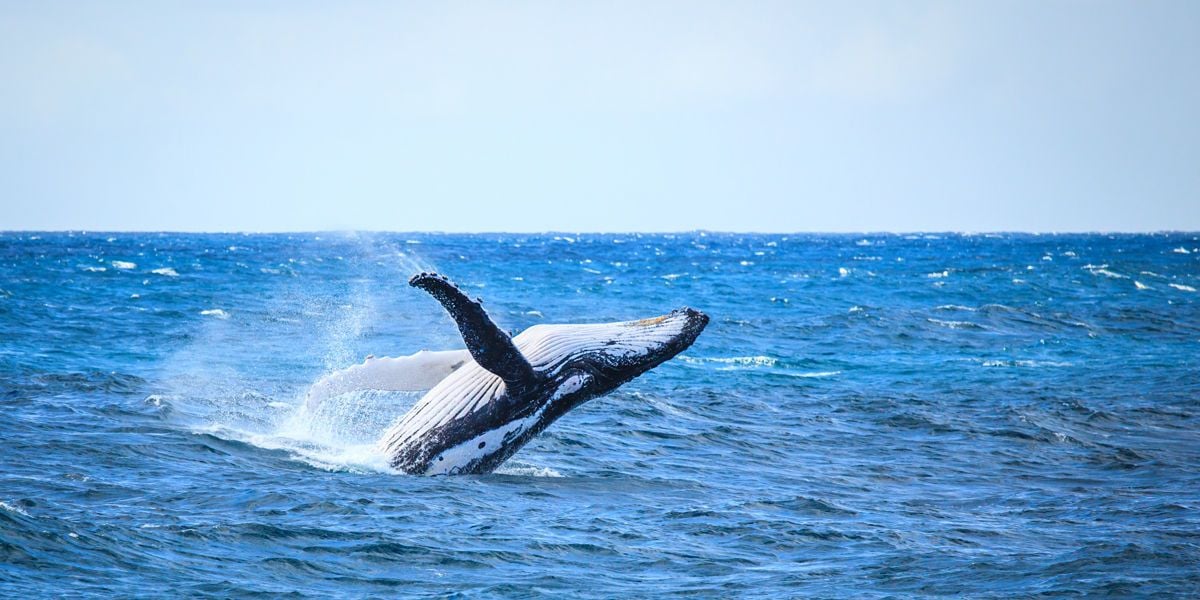
It’s not just Australia’s southern dwellers that like to migrate north for the winter. Our barnacled friends from the Antarctic are also quite fond of making the pilgrimage to frolic in the warmer Queensland waters.
Between March and November, the humpback whales of Antarctica will journey 10,000km (5,000kms each way) to spend their winter in the warmer waters off Queensland’s coastline before returning home for the summer.
The fact that we can see this incredible feat of nature taking place from the mainland, let alone get within splashing distance on a whale-watching tour, is something to be treasured.
Visitors from interstate and overseas flock to Queensland to see this spectacular display. But sometimes we locals get a little blasé about what’s going just offshore.
And that’s why we propose that, for locals, just like the migration, whale spotting should become an annual event. So why not make it your mission to spot a whale or two before they all slip back down to the Antarctic for the summer?
With over 30,000 humpback whales making the journey up and down our eastern coastline this year, your chances of spotting some are pretty good. You just need to know where to look… more about that a little later.
Why do the whales make the journey?
It seems that the warm and sheltered tropical waters of Queensland’s Great Barrier Reef provide the perfect conditions for female humpback whales to give birth to their calves.
The new family members then typically spend some time getting to know one another in the waters around Hervey Bay before setting off for the long trip home.
Generally, the whales migrate north between March and August and then head back down the coast toward the Southern Ocean from September to November.
With talk of the humpback whale population soon reaching its peak (after all, there’s only so much krill to go around) it’s a wonderful time to try to spot one of the thousands of whales frolicking up the humpback highway along Australia’s east coast.
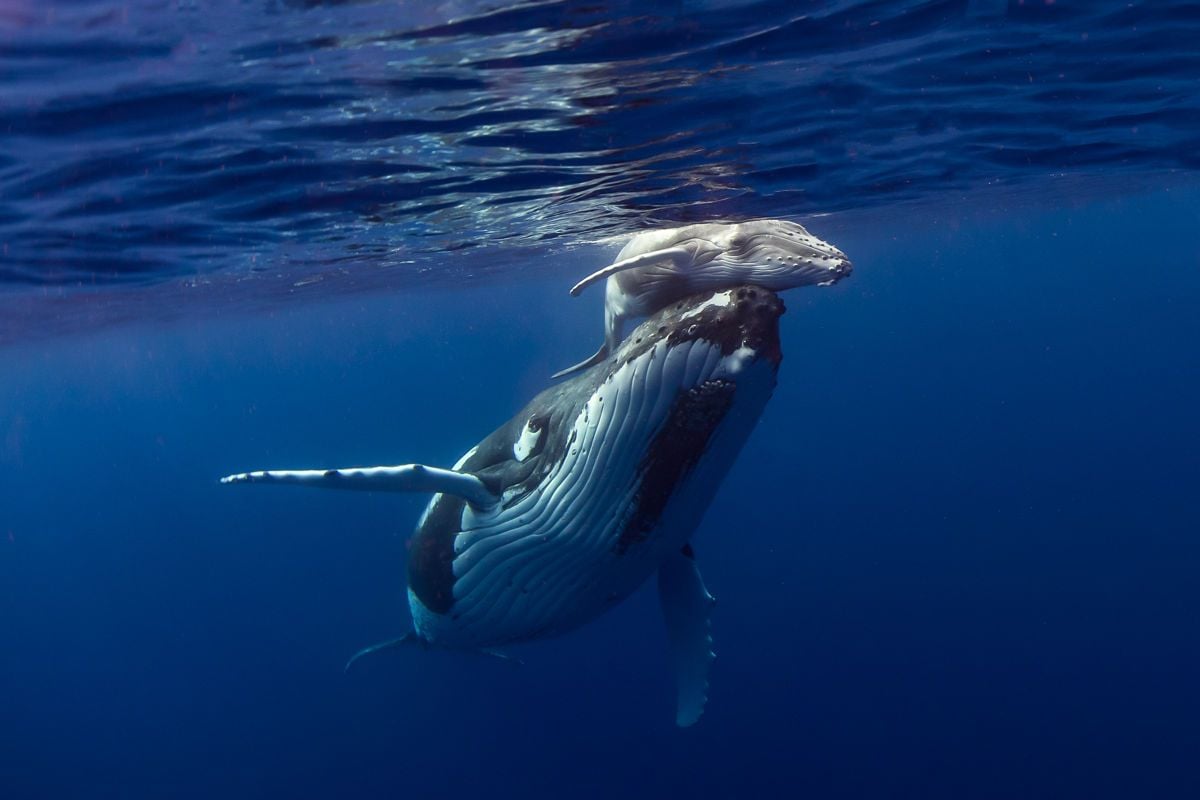
The humpback’s ability to care for their young is a sign of their intelligence.
Let’s get to know our Antarctic neighbours
There’s no question that humpback whales are incredible creatures of the deep. If you need any convincing, here are just a few amazing facts about the humble humpback:
- The average humpback is around 12 to 14 metres long with some even growing as big as 16 metres in length.
- A fully-grown adult whale weighs in at an impressive 25 to 30 tonnes.
- The birth announcement for a baby humpback calf might read something along the lines of: “Welcome to the world Humpy Junior, weight 900 kilograms, Length 4 metres.” (Let’s spare a moment’s thought for the mumma whale that births one of these bundles of joy every two to three years.)
- Humpback whales eat up to four tonnes of krill and small fish a day in their feeding season over the Antarctic summer.
- Humpback whales can live to 100 years old however the typical life expectancy is 45-50 years.
- With a humpback whale’s brain weighing more than five kilograms, it’s no wonder they are considered intelligent animals. Their natural inquisitiveness is a sign of this intelligence as well as their ability to care for and protect their young and injured.
Remember to keep an eye out for Migaloo
Migaloo, meaning ‘white fella’ in aboriginal language, is the most famous of all the humpback whales that frequent the waters off Australia’s eastern coastline
Migaloo is an all-white humpback whale and was first spotted way back in 1991 while passing by Byron Bay. At the time, he was the only known white humpback whale in the world.
Believed to have been born in 1989, Migaloo is celebrating his 30th birthday (or there abouts) this whale-watching season.
He has already been spotted this year (the first time back in May near Sydney and more recently off Port Douglas) so keep an eye out for him on his return trip to Antarctica.
However, if you happen to be out on the water and spot him, please remember that he is a protected whale which means you must keep your distance to at least 500 metres.

There’s nothing like the feeling of spotting your first whale.
Where to spot a whale on the Sunshine Coast
The Sunshine Coast is lucky to enjoy a longer whale watching season as the whales make the journey north and then again south with their newborn calves in tow.
Obviously, a whale-watching tour is the best way to see humpback whales doing what they do best in their native habitat. If that’s what you’re looking for you are spoilt for choice. There are a number of tours that depart from Brisbane and the Sunshine Coast without doing the drive to Hervey Bay.
But if you get a bit green at the gills at the thought of bobbing across the ocean, or the cost is simply not in your budget right now, don’t think you’ve missed your chance. There are a number of stunning locations along the Sunshine Coast that make it possible to spot a whale without your feet leaving the mainland.
Pack a picnic, your camp chairs and the kids (if you have some) and set off to find yourself the perfect vantage point for a sunny afternoon of whale watching. Make sure you also throw in a couple of sets of binoculars (better still, a set each as there is nothing more frustrating than watching someone else watching a whale).
To help you on your quest, we’ve put together some of the ‘top’ spots on the coast for spotting a whale. While land-based sightings might not be as up close and personal as if you were out on boat, it’s still really exciting to spot a pod of whales in the distance and the unmistakeable spray of a whale blow. It’s also a pretty cool reminder that these enormous, majestic creatures are swimming casually by, just off-shore.
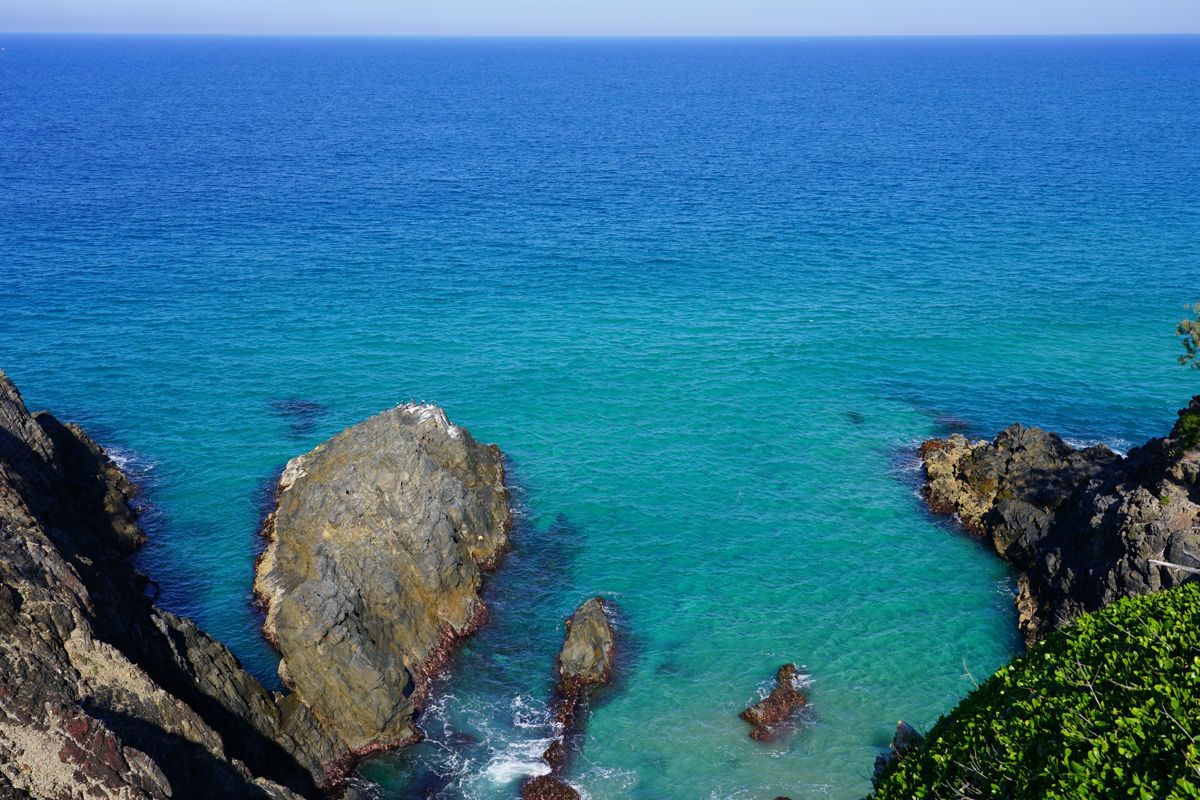
There’s nothing like the feeling of spotting your first whale.
Noosa National Park
At the northern end of the Sunshine Coast, the Noosa Heads Coastal Track is a spectacular choice for a whale-spotting day out. Wrapping around the Noosa headland, the track offers ‘take-your-breath-away’ views out across the Pacific Ocean. About 20 minutes along the track you’ll get to Dolphin Point – one of the best spots on the coast to spy a whale. Dolphin Point is also a great spot to see…you guessed it, dolphins.
Accessibility: Starting from the carpark at the Park entrance, it’s about a 20-mimute walk along a bitumen path to Dolphin Point. The track is a well-maintained bitumen path making it assisted wheelchair and pram friendly.
Point Perry
With spectacular views out across the Coral Sea, Point Perry in Coolum is one of the best whale-watching spots on the Sunshine Coast.
The lookout is at the southern end of Coolum village, just a short walk up the boardwalk from Coolum Beach and the main shopping strip.
Public toilets are also provided at the point, so you can happily plan to settle in with the family for the afternoon.
Accessibility: The area is wheelchair and pram friendly with a carpark right at the top or you can enjoy the 10-minute stroll up the boardwalk from the public carpark next to Coolum Surf Club.
Point Arkwright
Just a little further south, Point Arkwright’s views are just as stunning as Point Perry and offer similar whale-spotting opportunities.
Point Arkwright Headlands Park offers covered picnic tables and public toilets are provided so there’s no reason not to plan to stay for a while.
Accessibility: There’s a public carpark right next to the picnic area with a concrete path leading to the picnic area. You can also reach the park via the Coolum Boardwalk that continues on from Point Perry.
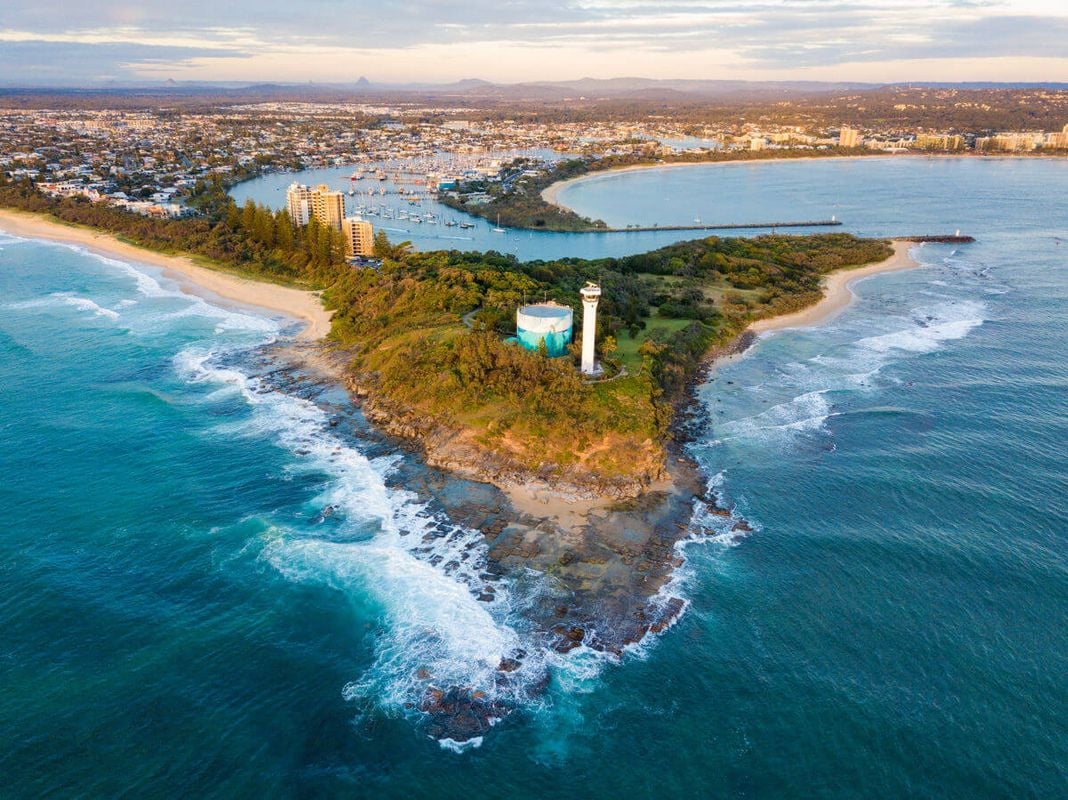
Humpback whales have been spotted from Point Cartwright near Mooloolaba on the Sunshine Coast.
Point Cartwright
Head out the path to the tip of Point Cartwright and you’ll certainly feel like you are closer to the whales. This headland sits out proudly from the coastline and is home to the Point Cartwright Lighthouse and iconic water reservoir.
Humpback whales have regularly been spotted from the point from the rocky cliffs below the lighthouse. The Point Cartwright headland is one of those spots that makes you feel a world away from the bustle of Mooloolaba. Pack a picnic and head out for a few hours or R&R. Just don’t forget to keep one eye open to spot the whales.
Accessibility: Parking is available off Pacific Boulevard, just as you enter the reserve. While it’s undeniably a longer walk to this vantage point than some of our other suggestions, the path is paved and it is well worth the effort.
Caloundra
Between Kings Beach and Shelly Beach, the Caloundra Memorial Walkway around the headland offers endless opportunities to enjoy the views and potentially spot a whale or two.
With lookouts, bench seats and picnic tables dotted along the way, there’s sure to be a spot that ticks all the boxes. Accessibility: Street parking is available at numerous points along Esplanade Headland and Victoria Terrace. The Memorial Walkway is fully paved making it suitable for wheelchairs and prams.
Spot a winner at our Sunshine Coast Prize Home
While you’re on the coast spotting whales, why not make a day of it and visit our latest Sunshine Coast Prize Home. You may even spot the future winner in
your travels (hopefully while you’re looking in the mirror).
Find out more about the latest Endeavour Prize home including address details and directions or take a virtual tour.
Entering the draw can be life-changing in more ways than one
When you purchase lottery tickets from Endeavour Foundation, you help to provide opportunities for people with an intellectual disability to learn life skills, live independently, have a job they love, and be actively involved in their local communities. Find out more about how Endeavour Foundation is helping people with disability to imagine what’s possible.

We would love to hear from you
How was your experience? Let us know what you think!


Customer Support and Ticket Sales
1800 63 40 40
Endeavour Lotteries run on AEST (and a Little Bit of Good Luck). All times show in your device’s local time zone, unless stated otherwise.